
Curation over volume
We would rather keep building a library where every 3D model and scene is worth exploring than pad the shelves. New lessons are added as our team finishes developing them, so quality comes before quantity.
Immersive Learning is a mobile extended-reality learning service. We build and curate 3D models, 360-degree scenes and guided lessons across cultural heritage, art, space science, archeology and the natural sciences, designed for a phone screen first, then wrap them in a single subscription anyone with a mobile number can start.
Most extended-reality learning still asks for a headset and a spare room. Immersive Learning takes the opposite route: every 3D model and 360-degree scene in the library is built to run on the device you already carry, so a lesson on the human body or the rings of Saturn is always one tap away.
That constraint shapes everything. Categories sit one tap from the home screen, navigation is designed for a thumb, and tapping any point of interest inside a scene brings up a short note on what it is and why it matters.
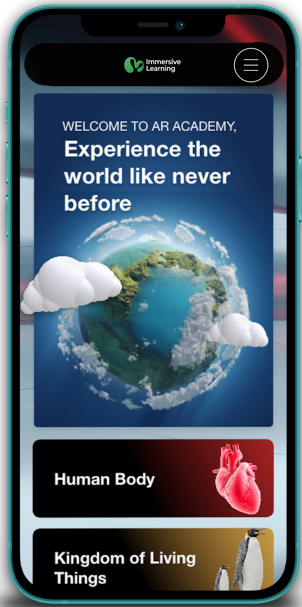
Three commitments shape every decision we make about the library and the subscription behind it.
We would rather keep building a library where every 3D model and scene is worth exploring than pad the shelves. New lessons are added as our team finishes developing them, so quality comes before quantity.
A scene that stutters teaches nothing. Every lesson is built to run on an ordinary smartphone over an internet connection, and to work just as well if you do put on a VR headset.
Clear pricing, no lock-in, and a cancellation that takes one text message. You should never have to hunt for the exit, and you should always be able to see exactly what you pay and how often.
We want extended-reality learning to be something you pick up on a bus, not something you schedule.
Headsets will keep improving, and Immersive Learning already works with the ones on the market today, from cardboard to Oculus. But the phone is where most people meet this kind of learning for the first time, and that first meeting deserves to be good: quick to start, easy to follow, and interesting enough to come back to tomorrow.
So we keep working on the parts that are easy to overlook: how fast a scene loads, how an info note is worded, and making sure the library keeps growing with content worth exploring.